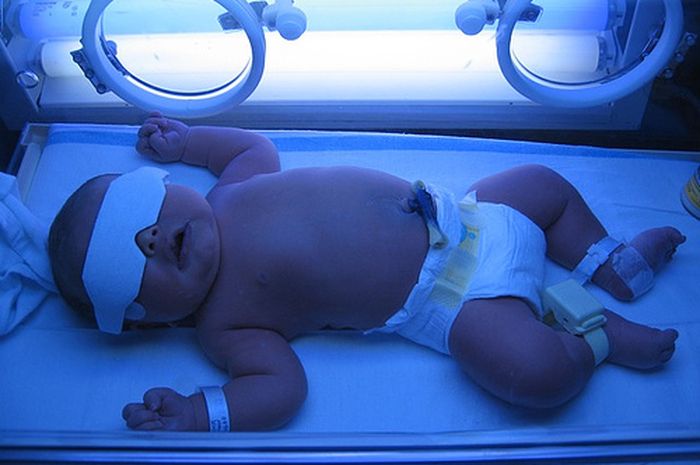

Understanding Hyperbilirubin
Bilirubin is a yellow pigment in blood and feces or a waste substance formed from the breakdown of red blood cells. This condition can be caused by physiological, pathological processes, or a combination of both. Hyperbilirubin occurs when the level of bilirubin in the baby’s blood is too high, causing the baby to look yellow.
Hyperbilirubin will occur if bilirubin is not processed properly by the liver. This can happen because the amount of bilirubin produced from destroying blood cells is too much, so the liver does not have time to process it, or because there is a problem with the liver. When this happens, the surface of the skin and the whites of the eyes become yellow, this condition is called jaundice.
Some causes of abnormal jaundice in babies include:
- Incompatibility (incompatibility) rhesus or blood type between mother and baby.
- Blood disorders.
- Infection.
- Bruising on the head due to the birth process, especially with vacuum assistance.
- The bile duct is blocked or not formed (biliary atresia). Usually accompanied by pale colored stools.
An increase in bilirubin levels, apart from yellow skin, can also be seen where the urine becomes dark yellow in color, and the whites of both eyeballs become yellow. To confirm this, it is necessary to check blood bilirubin levels through a blood test.
Blood tests to determine normal levels of bilirubin
Carrying out a blood test is very necessary to determine the bilirubin level. This examination is carried out in the first few days after the baby is born. This is to prevent the possibility of dangerous impacts occurring and threatening the baby’s safety. In newborn babies, normal bilirubin levels should be below 5 mg/dL. However, quite a few newborn babies have bilirubin levels that exceed these levels. For some cases of mild jaundice in newborn babies, no special therapy or medical treatment is needed. This condition can heal by itself within 2-3 weeks. However, for more severe conditions, intensive treatment by a doctor at the hospital is necessary.
Treatment given by doctors aims to prevent dangerous conditions, namely kernicterus, due to jaundice that is left for too long. This condition is a type of brain damage caused by high levels of bilirubin in the baby’s blood.
The following are high bilirubin levels according to the baby’s age:
- More than 10 mg/dL in babies less than 1 day old.
- More than 15 mg/dL in babies aged 1-2 days.
- More than 18 mg/dL in babies aged 2-3 days.
- More than 20 mg/dL in babies more than 3 days old.
How to Treat High Bilirubin Levels
The following are several treatments that can be done in an effort to reduce bilirubin levels to normal in newborn babies, including:
- Light therapy (phototherapy).
Phototherapy therapy, here the baby will be placed under a special light that appears greenish blue. It is hoped that the light will help change the bilirubin molecules so that they can be excreted through urine and feces. During this process, babies are only allowed to wear diapers and eye protection. - Immunoglobulin transfusion.
This is a further step for treating jaundiced babies, especially those caused by differences in the rhesus blood types of the baby and the mother (rhesus incompatibility). This condition causes the baby to get a lot of antibodies from the mother’s body, which will attack the baby’s blood cells, resulting in the breakdown of many blood cells. Giving an immunoglobulin (IVIg) infusion can help reduce the number of antibodies, so that jaundice can be resolved. - Blood exchange transfusion.
Treatment in this way is only carried out if the baby has severe jaundice that does not show a response to other therapies. A blood replacement transfusion is carried out by taking a small portion of blood from the baby’s body, then replacing it with donor blood, and is done repeatedly. The goal is so that the blood in the baby’s body is free from high levels of bilirubin and maternal antibodies.
Normal bilirubin levels are a sign of a healthy baby. If the baby looks jaundiced and is suspected of having too high bilirubin, the mother should immediately take action to have the baby checked by a pediatrician so that appropriate treatment can be given.