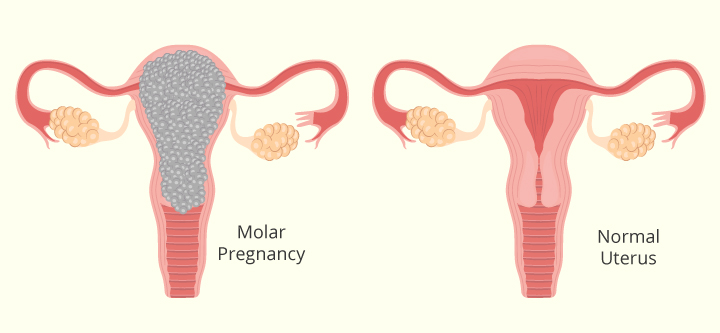

Molar pregnancy, also known as the medical term Hydatidiform mole, is a failed pregnancy. Egg cells that have been successfully fertilized should grow into a placenta and fetus, but over time, the egg cells fail to develop and end up forming a collection of cysts that are shaped like white grapes. Not many/very rare pregnant women experience this disorder. However, molar pregnancy should be treated immediately so that it does not develop into a serious disease, one of which is gestational trophoblastic disease which can only be cured by surgery or chemotherapy.
In early pregnancy, molar pregnancy is difficult to detect because at first it is similar to a normal pregnancy. A molar pregnancy will be detected by an obstetrician during a routine pregnancy check-up. Someone who has experienced a molar pregnancy will be more at risk of experiencing a molar pregnancy again in the future. After finding out that you are positively pregnant, immediately check with your obstetrician regularly, at least once a month. This examination aims to determine the condition of the fetus’ development as well as detect if there are any abnormal conditions, both in the fetus and in the uterus. It is also necessary to check with a gynecologist outside of the control schedule if you feel symptoms of molar pregnancy. You need to be careful if you have experienced a molar pregnancy, because there is a risk of experiencing it again.
Symptoms of Molar Pregnancy
The signs of a molar pregnancy are initially the same as a normal pregnancy. However, as gestational age increases, molar pregnancy (hydatidiform mole) can be characterized by special symptoms, such as the following:
- Bleeding from the vagina in the first trimester. This bleeding is sometimes similar to implantation bleeding.
- Very severe nausea and vomiting.
- Very rapid development of the uterus, exceeding normal limits at a certain gestational age.
- Discharge of brownish fluid or grape-like lumps from inside the vagina.
- Pain or pressure in the pelvic floor, which is quite rare
- The emergence of symptoms of hyperthyroidism such as fatigue, nervousness, irregular heartbeat, and excessive sweating.
If a pregnant woman experiences the symptoms above, immediately consult a doctor, usually the doctor will detect other signs of molar pregnancy such as the following:
- Early hypertension/preeclampsia in the early weeks of pregnancy
- Anemia
- The appearance of ovarian cysts
- Increased thyroid gland activity/Hyperthyroidism (the thyroid gland is too active and produces excessive thyroxine hormone)
- No fetal movement or heartbeat was detected
- Increased hCG levels
It is highly recommended to have regular self-examinations with a gynecologist during recovery after a molar pregnancy. Ask your doctor when you can get pregnant again after experiencing a molar pregnancy.
Causes of Anger Pregnancy
Molar pregnancy is caused by a chromosomal imbalance during pregnancy. Based on the cause, molar pregnancy is divided into 2 types, namely:
- Complete molar pregnancy.
This condition occurs when an egg cell that does not contain genetic information is fertilized by sperm and fails to develop into a fetus, but instead grows into a collection of abnormal tissue called a mole, which over time can fill the uterus. - Partial molar pregnancy.
This condition occurs when one egg is fertilized by two sperm simultaneously. As a result, placental tissue will develop abnormally and turn into a mole, while fetal tissue that successfully develops will experience serious defects or abnormalities.
Risk Factors for Molar Pregnancy
There are several factors that are thought to increase a woman’s risk of experiencing molar pregnancy (hydatidiform mole), including:
- Pregnant at the age of more than 35 years.
The risk of molar pregnancy tends to be higher in women who are pregnant over the age of 35 years, or under 20 years of age who are also more at risk of experiencing molar pregnancy. - Have a previous history of molar pregnancy.
Someone who has experienced a molar pregnancy before is also at risk of experiencing a molar pregnancy in the next pregnancy. - Have had a miscarriage.
A woman who has had a miscarriage is more at risk of experiencing a molar pregnancy than those who have not
Diagnosis of Molar Pregnancy
As previously explained, the early signs of molar pregnancy are almost the same as normal pregnancies in general. Pregnant women will usually be detected as having a molar pregnancy during routine pregnancy checks. The first visible sign is abdominal enlargement that is not appropriate for gestational age. Then the obstetrician can detect molar pregnancy (hydatidiform mole) through pregnancy ultrasound and blood tests. In a blood test, the doctor will look at the levels of the pregnancy hormone chorionic gonadotropin (HCG). Molar pregnancy sufferers will have hormone levels that are higher than they should be.
During a pregnancy ultrasound examination, around the 8th or 9th week of pregnancy, the obstetrician will find the following signs if the pregnant woman is experiencing a complete molar pregnancy:
- There is no fetus in the womb.
- No amniotic fluid visible.
- An ovarian cyst appears.
- The placenta thickens almost to fill the uterus.
- The placenta is shaped like a bunch of grapes.
In women who experience a partial molar pregnancy, a pregnancy ultrasound examination can show:
- Stunted fetal growth.
- Little amniotic fluid.
- The placenta thickens.
After being diagnosed with a molar pregnancy, the doctor will advise the sufferer to carry out other blood tests to find out whether the sufferer has preeclampsia, hyperthyroidism, or anemia.
Management of Molar Pregnancy
Most sufferers of molar pregnancy (hydatidiform mole) will experience spontaneous miscarriage. Miscarriages usually produce tissue in the form of lumps that resemble a bunch of grapes. If you do not experience a miscarriage, the doctor will take immediate treatment to prevent worse complications.
Actions that can be taken by obstetricians include the following:
- Curettage action.
In performing a curettage, the doctor will dilate the cervix and remove abornmal tissue with a special tool. This procedure is the best choice if the sufferer plans to get pregnant again. - Hysterectomy procedure.
Hysterectomy is the removal of the uterus. This procedure is only performed on patients who do not plan to become pregnant again or are at high risk of developing dangerous diseases such as gestational trophoblastic neoplasia. - Recovery action.
After curettage, abnormal cells may still remain in the uterus. These cells will usually disappear within a few months. However, in some cases, further treatment is needed to eliminate it. To ensure that the abnormal cells have disappeared, sufferers need to have their HCG levels checked, through blood and urine tests. These hormone levels should return to normal after removal of the abnormal tissue. If hormone levels remain high, it means that there are still abnormal cells remaining in the uterus. This examination is carried out 6 months to one year after experiencing molar pregnancy. Apart from that, sufferers are also advised not to get pregnant within one year after experiencing molar pregnancy.
Molar Pregnancy Complications
There are several complications that can arise after experiencing a molar pregnancy (hydatidiform mole), including:
- Gestational trophoblastic neoplasia.
This complication occurs more often in sufferers of complete molar pregnancy, which is characterized by HCG remaining high after curettage. Gestational trophoblastic neoplasia occurs when abnormal cells enter the middle of the uterine wall. - Choriocarcinoma.
Choriocarcinoma is a cancerous form of gestational trophoblastic neoplasia. Although rare, this cancer is more often experienced by people with complete molar pregnancy. - Experiencing molar pregnancy again.
Those suffering from molar pregnancy are at risk of experiencing molar pregnancy again in subsequent pregnancies. This risk is higher if experienced by sufferers who have experienced several molar pregnancies or those who have had miscarriages.
Efforts to Prevent Molar Pregnancy (Hydatidiform Mole)
Molar pregnancy occurs due to a gene error in the fertilization process. Therefore, this condition is difficult to prevent. However, there are several efforts that can be made for molar pregnancy sufferers to reduce the possibility of something similar occurring in subsequent pregnancies. One effort to reduce the risk of experiencing a molar pregnancy (hydatidiform mole) again is to postpone pregnancy, at least a year after curettage. To prevent pregnancy, use contraception. All contraceptives can be used, except the IUD. Routine examinations with an obstetrician need to be carried out if you become pregnant again after a molar pregnancy, to ensure that the growth of the placenta and fetus is normal.