
The benchmark for providing complementary foods for breast milk for babies is not only based on their current age. Mothers also need to recognize several signs to determine whether the baby is ready to be given complementary foods. What are the typical signs that indicate a baby is ready to learn to eat?
Signs that the baby is ready to eat complementary foods
Ideally, it is recommended that babies be given complementary foods when they are 6 months old. Along with the process of being introduced to food, babies still need breast milk intake at certain times according to their feeding schedule. This aims to ensure that the baby’s daily nutritional needs are met properly. However, apart from considering the baby’s current age, mothers also need to look for signs that the baby is ready to eat complementary foods.
The following are signs that a baby is ready to recognize and learn to eat complementary foods for breast milk:
- Signs that the baby is physically ready to eat complementary foods for breast milk
Paying attention to the baby’s physical changes as signs that he is ready to eat complementary foods is usually easier to see. Because as the baby gets older, there are many changes in the baby’s physical abilities that he will show. To reassure mothers, here are the physical signs when a baby is ready to eat complementary foods: -
- Able to hold the head and neck upright
According to the Indonesian Pediatrician Association (IDAI), one of the instructions for starting to give breast milk complementary foods to a baby is when he can lift his head on his own. Apart from lifting his head on his own, make sure the baby can also hold his neck straight without having to lean or be given help. This is because when the head and neck can stand upright stably, it is a sign that the baby is ready to maintain body balance when eating. - Able to sit alone
A baby is said to be ready to learn to eat complementary food when he appears to be able to sit on his own with little or no help at all. It’s even better if when sitting alone the baby is able to maintain his body balance, especially as long as one or both hands are trying to reach objects around him. - The tongue protrusion reflex is reduced.
During the six months that a baby is exclusively breastfed, he is required to have the ability to suck and stick out his tongue. This aims to make it easier for the baby to breastfeed by sucking on the mother’s nipple. However, at the age of 6 months, the baby’s ability to stick out his tongue will usually decrease. If the mother sees this happening to the baby, this is one of several signs that the baby is ready to eat complementary foods for breast milk. - Baby’s oromotor skills are getting better.
Oromotor or oral motor skills are babies’ abilities that involve the muscle movement system in the oral cavity area. The muscle movement system in the mouth area includes the teeth, jaw, tongue, lips and roof of the mouth. If previously the baby was only able to suck and swallow liquids, now he can chew and swallow food with a thick and dense texture. Not only that, the baby’s motor skills are also visible when he can move food from the front to the back of the mouth. - Seems interested in food.
Babies who are ready to eat complementary foods will usually show interest when they see the food in front of them. Take for example, the baby is seen trying to move his body to reach food nearby. - Have good hand and mouth coordination.
Good coordination between hands and mouth can facilitate the process of learning to eat for babies. Pay attention when the baby pays a lot of attention, takes, and directs the food he takes into his mouth, this is a sign that he is ready to eat complementary food for breast milk.
- Able to hold the head and neck upright
- Psychological signs that a baby is ready to eat complementary foods for breast milk
Rather than physically recognizing signs that a baby is ready to eat Complementary Food, seeing the psychological characteristics when a baby is able to learn to eat may be more difficult. However, this does not mean that mothers cannot be sensitive to the psychological signs that babies are ready to eat complementary foods. Here are some signs that show your baby is ready to know and try food: -
- Start imitating other people’s way of eating (imitation)
Signs that a baby is ready to receive complementary foods from a psychological perspective are a change in actions based on reflexes (reflective) to imitation (imitative). The meaning is this, babies who previously could only reflexively breastfeed when they were hungry, are now starting to be able to learn to eat by imitating and watching other people. - Looks more independent and willing to learn
Babies who are ready to receive complementary foods will usually appear more independent and willing to learn to eat on their own. This is because babies no longer just suckle breast milk when they are hungry, but also have to learn to recognize food and eat on their own. Here, as a parent, you should not make mistakes when accompanying and teaching your baby about food. Also teach and introduce babies to various types of food so that they don’t like to be picky eaters when they grow up. - Shows desire to eat
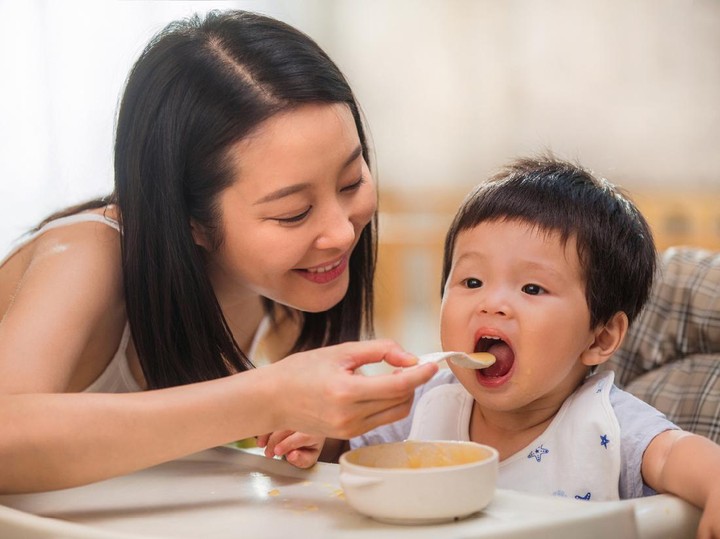
When a baby is ready to get to know complementary foods, he usually shows his desire to eat by opening his mouth. They even show signs of hunger by positioning their body forward or towards the food. Meanwhile, when he doesn’t want to eat or is full he will pull his body away from the food. - Shows signs of hunger
Breast milk intake, which previously met the baby’s nutritional needs, now seems inadequate because he shows signs that he is still hungry and wants to eat. Signs that can be seen when a baby is still hungry include continuing to cry, whine, restlessness, and restlessness even though he has received enough breast milk. - Be curious about what other people eat
Babies who are ready to eat complementary foods generally look like they want to try or are curious when they see other people eating. So, when the mother sees the baby and he tries to take the food that is in the mother’s hand, it could be a sign that he is ready to eat complementary foods.
- Start imitating other people’s way of eating (imitation)
- Another sign that deceives the baby’s readiness to eat complementary foods for breast milk
Many parents are fooled by false signs and think that their baby is ready to eat complementary foods, even though they are not. Yes, there are baby habits that are often misinterpreted as signs that they are ready to be given MPASI. This then makes parents make mistakes and end up giving solid food too early before it’s time.
Several signs that are often misinterpreted as a baby’s readiness to eat complementary foods include:
-
- Chewing his fist.
- Waking up in the middle of the night because he was hungry even though he usually slept more often.
- Breastfeed in larger quantities.
The point is, when you see your little one showing some of these signs, don’t immediately jump to the conclusion that it’s time for him to get to know complementary foods for breast milk. Again, try to pay attention to other characteristics to better ensure the baby’s readiness in learning to recognize food.
It’s best to wait until 6 months of age
Even if you see signs that your baby is ready to learn to recognize and try his first food, it’s a good idea to wait until your baby is around six months old. Waiting up to six months to give your baby his first food will help protect his health.
This is because at the age of six months the baby’s immune and digestive systems are much stronger, thereby reducing the risk of experiencing allergies, digestive disorders or infections from food.
If there is one reason or another that makes the mother plan to start feeding the baby before six months, you should consult further with your trusted doctor or midwife.